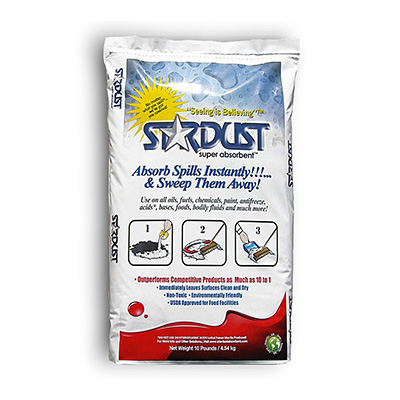
STARDUST
Ecological super-absorbent. Absorbs 7 to 20 times more than traditional clay-based absorbents. Absorbs liquids of any viscosity. USDA-approved for use in food production processes. Meets and exceeds LRT standards (Liquid Release Test). Meets and exceeds EPA standards for TCLP tests.
CODE
101
FORMAT
42.5 L bag
Superior performance compared to lower-cost products
- Absorbs 7 to 20 times more than traditional clay-based absorbent products.
- Non-selective, therefore there is no need to stock different types of absorbents.
- Reduces labor costs.
- Immediately effective.
- Extremely low cost of use.
- Lightweight and therefore easy to handle.
Economic benefits
- Reduces cleaning, labor, and material costs.
- Reduces disposal costs.
- Reduces management costs.
Eco-friendly and easy to use
- Not hazardous to people, animals, plants, soil, concrete, asphalt, or bricks.
- Unlike clay-based products, it is not classified as carcinogenic or as a substance that may cause silicosis (see safety data sheets of clay-based products).
- USDA approved for use in food production processes.
- Complies with OSHA specifications as stated in the “Bloodborne Pathogens Standard” (29 CFR 1910.1030).
- Meets and exceeds EPA standards regarding TCLP tests (Toxicity Characteristic Leaching Procedure). Therefore, it does not release substances into the environment.
- Meets and exceeds LRT standards (Liquid Release Test).
Petroleum products
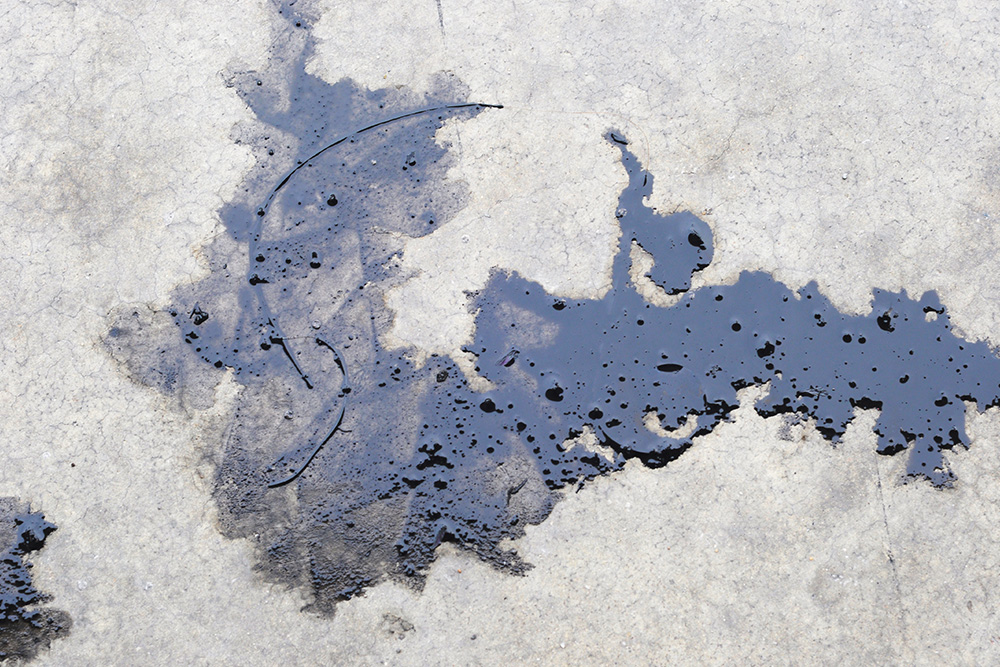
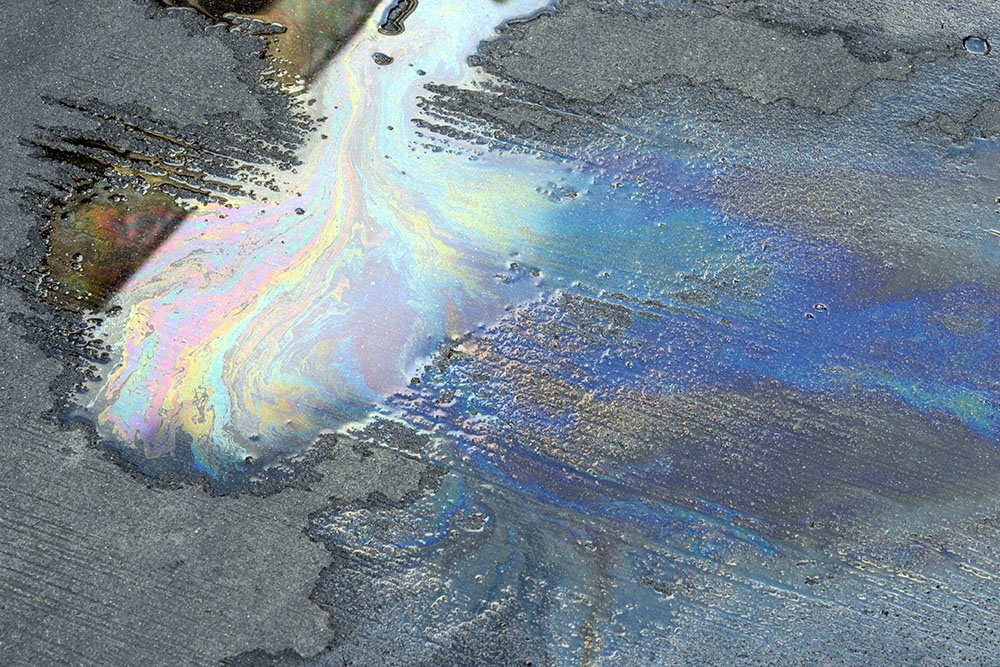
- Gasoline, diesel fuel, aviation fuel
- Hydraulic oil
- Engine oil
- Axle grease
- Refining or production waste
Paints and coatings
- Water-based, oil-based, or epoxy-based paints
Antifreeze
All food-derived liquid or semi-liquid substances
- USDA approved for use in the food industry
- Honey, syrups
- Jam, jelly
- Peanut butter
- Vegetable oils
- Beverages, vinegar, ketchup, etc.
All organic body fluids
- Human and animal body fluids
- Blood
All chemicals
- Herbicides
- Bases, alkalis
- Solvents
- Acids
- * DO NOT use STARDUST to absorb hydrofluoric acid
In any type of activity or industry, regardless of
the level of care taken, spills will always occur.
Many are minor, but in some cases spills of
products classified as hazardous may occur.
Traditional solutions are considered inadequate,
inconvenient, time-consuming, and very
expensive, and often the problem remains
unresolved.
- Aviation industry
- Airports, airlines
- Playgrounds
- Residential complexes
- Automotive repair activities (dealers, workshops, mechanical shops, body shops, etc.)
- Ministries and public institutions
- Construction companies
- Fire departments
- Food industry: producers and packers
- Fuel stations
- Municipalities and public utility companies
- Hospitals and care facilities
- Hotels, Restaurants, Catering
- Third-party maintenance companies
- Industry in general (automotive, aerospace, chemical, heavy mechanical, paper, pharmaceutical, etc.)
- Mines
- Funeral services
- Naval bases, ports
- Petrochemical industry (refineries, pipelines, warehouses, tanks, etc.)
- Livestock breeders
- Printing companies
- Waste recycling companies and used oil collection
- Transportation companies (trains, buses, aircraft, ships, etc.)
- Hydroelectric, thermoelectric, nuclear, geothermal power plants, etc.
- Wineries
- Cement plants
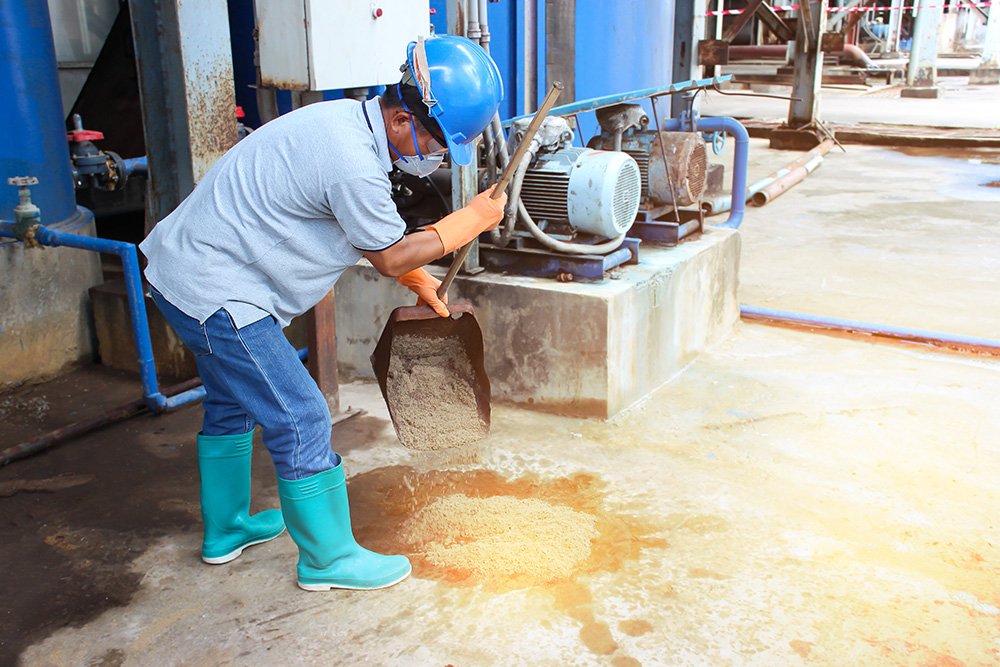
- Pour STARDUST onto the spilled liquid, completely surrounding it. If the spill is ongoing, apply STARDUST until a barrier is formed. The required amount depends on the volume of liquid to be absorbed.
- Using a stiff-bristle broom, press STARDUST onto the affected surface. Then, with circular movements and keeping the broom perpendicular to the surface, mix STARDUST with the spill until the liquid is completely absorbed.
- If insufficient STARDUST has been used and it becomes saturated before absorbing all of the product, apply additional STARDUST and repeat the operation. It will be surprising to see how the spill disappears and the surface remains clean and dry.
- Once the spill has been absorbed, collect STARDUST using a broom and a dry cloth. The used material must be disposed of in accordance with applicable local regulations. For safety reasons, personnel must be properly trained and equipped when absorbing hazardous liquids.
When absorbing staining liquids such as paints,
STARDUST leaves the surface clean and dry.
However, if the surface is porous, the liquid may
penetrate the pores and leave stains. In this
case, simply spray Resolv Industrial Cleaner and
work the surface with an abrasive sponge or a
broom. This will release the material from the
pores, turning the stain back into liquid that can
be immediately absorbed by STARDUST. If
necessary, repeat the operation until complete
cleaning is achieved.
If the spilled product has high viscosity (generally grease), carry out the operation quickly and apply greater pressure than usual, starting from one side of the spill and proceeding until complete absorption. This method spreads the product over the surface and allows STARDUST to fully absorb it.
Store STARDUST in dry places.
If the spilled product has high viscosity (generally grease), carry out the operation quickly and apply greater pressure than usual, starting from one side of the spill and proceeding until complete absorption. This method spreads the product over the surface and allows STARDUST to fully absorb it.
Store STARDUST in dry places.